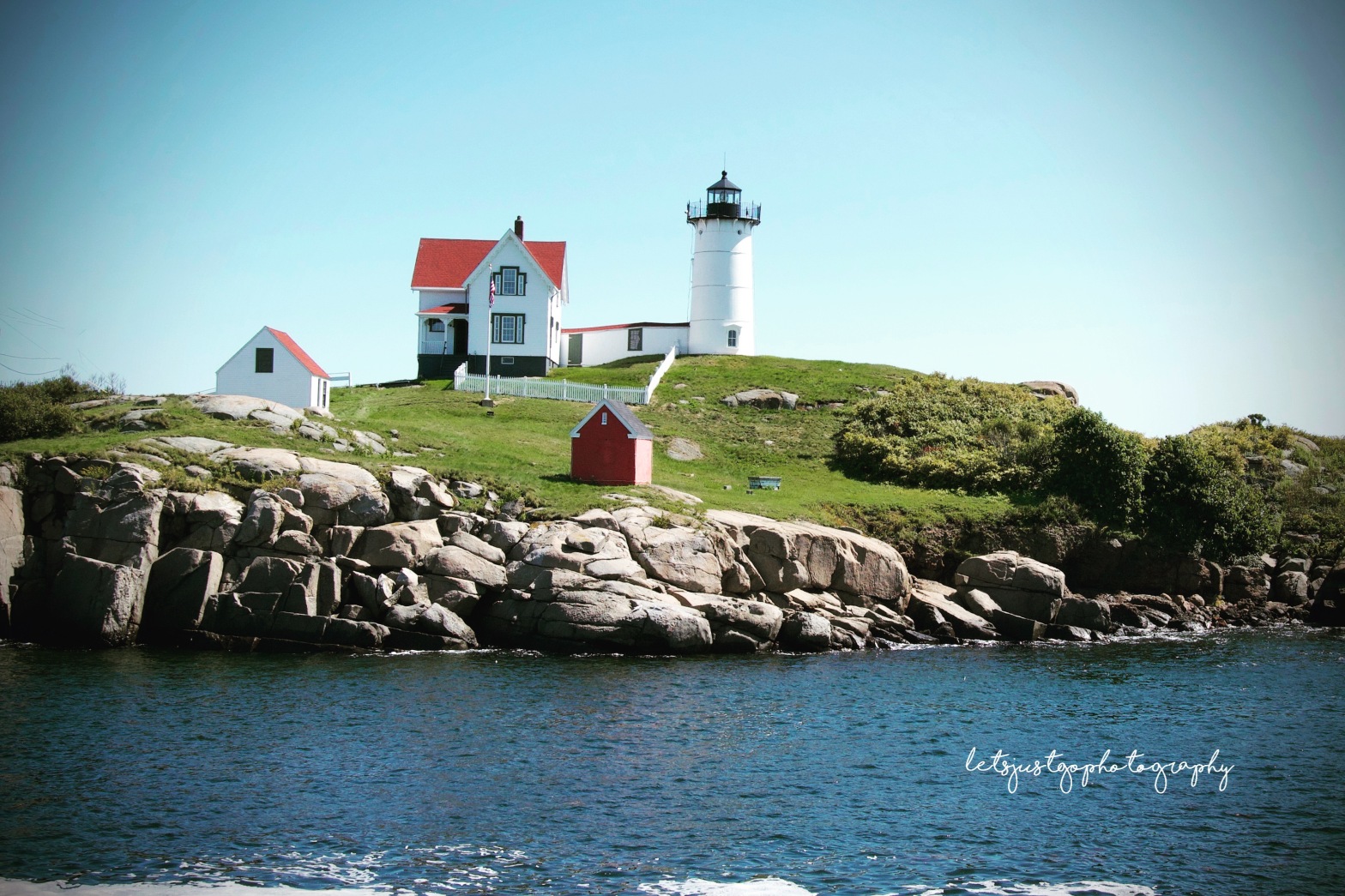
The rocky coastline that prominently outlines the State of Maine is treacherous to mariners but for more than two centuries, Maine lighthouses have served as beacons and markers through all weather conditions, lighting the way in the darkness.
The State of Maine is studded with 65 lighthouses, many of which are still active, serving their purpose of pointing the way for mariners to a safe harbor. Many are easily accessible and open to the public while others are remote and only accessible by boat. Each lighthouse is unique with its own story, light pattern, and landscape and they are all fascinating in their own way. In addition, if you have the chance to visit with the people who still care for these vital landmarks, you’ll find them to be friendly and full of information.
Inspired to check them out as many of them as many of them as we could, my husband and I did our research and headed to Maine to see some of the beautiful Maine lighthouses for ourselves.
LIGHTHOUSE #1: Cape Neddick Lighthouse/Nubble Lighthouse
We started our Lighthouse tour with the Cape Neddick Light.
As one of the most popular lighthouses in Maine, the Cape Neddick Light draws an estimated 500,000 visitors per year! Standing on Nubble Rock, 100 yards off of York Beach, the lighthouse and its Victorian-style keeper’s house are not accessible to the public and while you won’t be able to climb the light, a parking area is positioned on the point, and the lighthouse is easily viewed on a clear day.
Construction on the lighthouse began in 1879 and it is still in use today. Standing 41 feet tall and 88 feet above the water, the lighthouse has a cast iron skin that sheathes a brick interior. White with a black lantern, the lighthouse is an American icon with images of it being carried by the Voyager spacecraft as one of Earth’s most prominent man-made structures.
Cape Neddick Light is one of the last lighthouses in Maine to still have its Fresnel lens with a 13 nautical mile range flashing a red light alternating off for 5 seconds and on for 5 seconds.
The Cape Neddick Light was added to the National Register of Historic Places in 1985.

What to know before you visit:
Parking is free but limited to approximately 60 vehicles at a time. Bring along your patience when visiting. Designated handicapped parking is marked.
The landscape on the point is uneven, rocky, and very steep in some areas. Watch your step. Many visitors walk onto the rocks surrounding the parking area but caution should be taken. The rocks can be slippery at low tide.
Fox’s Lobster House Seafood restaurant, a welcome center, and a gift shop are at the base of the parking area.
Leashed dogs are welcomed.
We actually visited the Nubble Lighthouse twice and not because of the crowds! Instead, despite a clear travel day on our first visit, the closer we got to the lighthouse, the more Nubble Island became shrouded in dense fog and the lighthouse was barely visible. Keep in mind that Maine weather changes quickly, most notably along the coast.
LIGHTHOUSE #2: Marshall Point Lighthouse
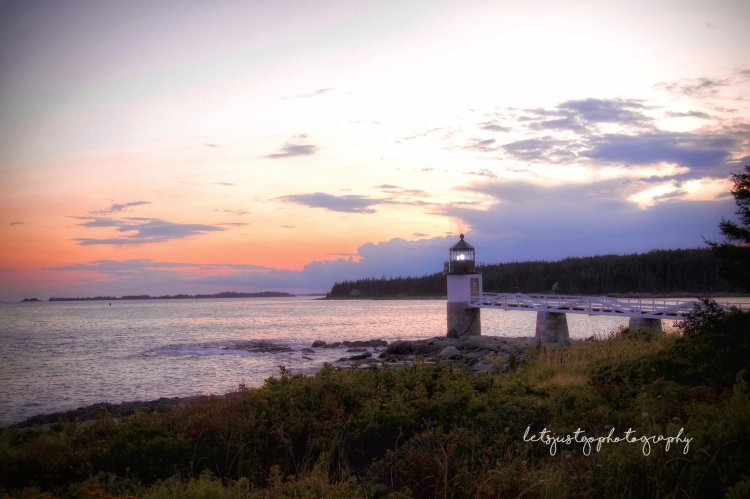
One of my favorite Maine lighthouses is the Marshall Point Lighthouse. Located on a rocky ledge at the tip of St. George Peninsula, the lighthouse serves both Muscongus and Penobscot Bays. The active light serves boats navigating Port Clyde Harbor with a range of 13 nautical miles.
The Marshall Point Light that we see today is the second structure on the property and the current light was first lit in 1858. At 31 feet tall, the white brick lighthouse is topped by a black lantern and its light is a fixed white light that has been automated since 1971. The lighthouse’s original Fresnel lens was moved to the Maine Lighthouse Museum in Rockland, Maine.
Today, the Keeper’s house, also still on the property, is the Marshall Point Lighthouse Museum.
Even if you’ve never visited the Marshall Point Lighthouse, you may recognize it from the 1994 movie, Forrest Gump.It’s brief appearance occurs at the point of the movie where our hero runs from coast to coast with his run taking him up the wooden walkway that connects the lighthouse to land, to the door of the lighthouse where he turns to continue running.
While the lighthouse protects the mariners who travel the waters in the area, it is not impervious to the weather and lightning strikes do occur. On July 27, 2023, the lighthouse was struck by lightning and the light, foghorn, and associated equipment were damaged. At the time of our most recent visit, exactly a month later, we were happy to find the lighthouse already repaired and back to work.
What to know before you visit:
A small parking lot is available for visitors and the lighthouse is a short walk over uneven ground. Designated handicapped parking is closer to the keeper’s house.
Leashed dogs are permitted.
No fee is charged to visit.
Sunset is the most beautiful time of day at Marshall Point but if you plan to visit at dusk, be aware of the mosquitoes!
LIGHTHOUSE #3: Owls Head Light
The Owls Head Light is an active navigational aid marking the entrance of Rockland Harbor in the town of Owls Head, Maine. It is the centerpiece of the 13-acre Owls Head State Park and became a location on the National Register of Historic Places in 1978.
The light is located 100 feet above Penobscot Bay, east of downtown Rockland.
At 30 feet tall, the white brick lighthouse sports a black lantern that houses one of the last six Fresnel lens still in operation in Maine. Owls Head has a 16 nautical mile range.
The lighthouse was built in 1852 with the Fresnel lens being installed in 1856.

What to know before you visit:
Parking is at the bottom of the hill and a five-minute wooded, uphill walk is required to approach the lighthouse. Additional ramps and 53 stepped staircase ultimately provides a vast panorama and on a clear day, Cadillac Mountain in Arcadia National Park, is easy to see.
No specifically handicapped parking was designated.
No fee is charged to visit.
The public is invited to climb the lighthouse to view the lantern. A donation is helpful. The staircase inside the lighthouse is one turn spiral with a short ladder entering the lantern.
Leashed dogs are welcomed but not inside the lighthouse.
LIGHTHOUSE #4: Pemaquid Point Light
Located in Bristol, Maine, the Pemaquid Point Light was commissioned by President John Quincy Adams but due to poor construction, the original lighthouse was replaced in 1835.
Originally lit with candles with a visibility of 2 miles, Augustine Fresnel invented a way of focusing light in the early 1850’s with Pemaquid Point Light receiving it’s Fresnel Lens in 1856 which, while automated today, is still in place and is one of only six remaining Fresnel lenses still in service in Maine.
The 38 foot lighthouse, constructed of rubble stone and concrete and is white with a black lantern, stands at the entrance of Muscongus Bay and projects a 14 nautical mile range.
The lighthouse was added to the National Register of Historic Places in 1985.

What to know before you visit:
Pemaquid Point Lighthouse Park is run and maintained by the town of Bristol. A nominal fee is charged to enter the park and a further donation is suggested for those wishing to climb the lighthouse.
Leashed dogs are welcomed.
Parking is plentiful and access to the lighthouse and park amenities is easy. Some areas of the park are rocky or have tree roots that need to be carefully considered to safely tour. The lighthouse is surrounded by a rocky apron that many visitors choose to climb onto. Caution is advised due to waves that can unexpectedly cause injury or worse.
The park has picnic tables available so consider bringing a picnic!
The park is open daily, 9a-5p, May through October. The lighthouse tower has limited hours and is open weather permitting.
The park also includes a learning center, art gallery, public restrooms, and fisherman’s museum. The park is tobacco free.
LIGHTHOUSE # 5 Portland Head Light
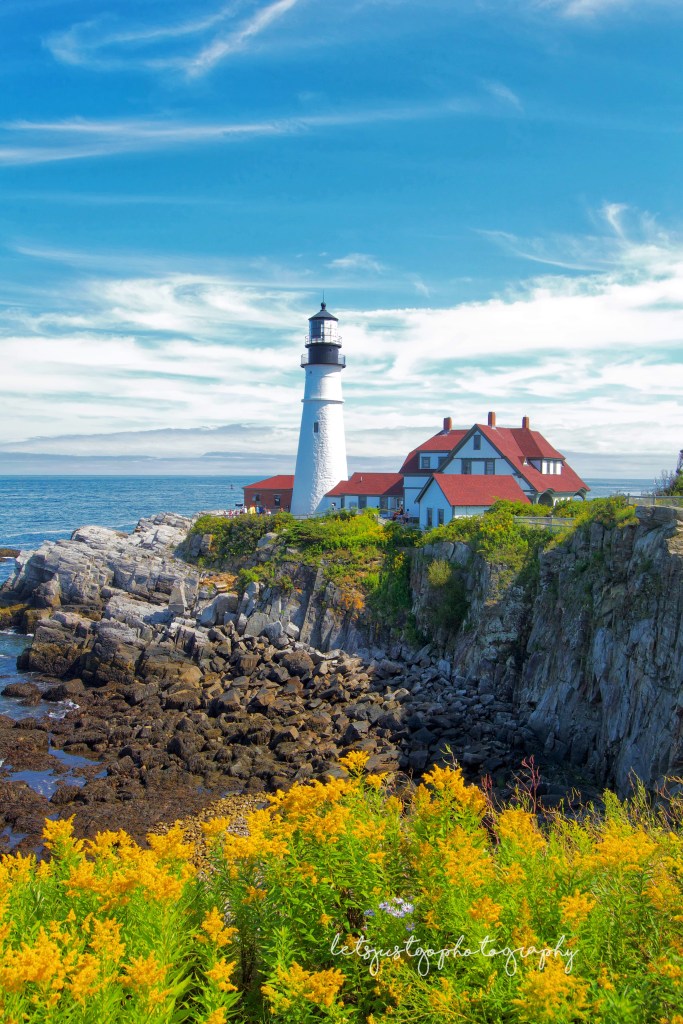
Portland Head Light sits at the entrance of the primary shipping channel into Portland Harbor, within Cisco Bay in Cape Elizabeth, Maine. Standing 80 feet tall and 101 feet above the water, the light is white with a black lantern framed by the red roof of the keeper’s house. Built with rubble stone with a brick lining, the current light’s range is 24 nautical miles.
As the first lighthouse built by the U.S. Government, Portland Head Lighthouse is know to be one of the most famous and most photographed lighthouses in the United States. Construction of the Portland Head Light began in 1787 and was completed in in 1791 using a fund of $1,500 established by George Washington in 1787.
The original light used whale oil for illumination but as technology progressed, the lighthouse received a 4th-order Fresnel Lens in 1864. The light was then raised 20 feet and it received a 2nd order Fresnel Lens in 1865 which remained in place until 1958.
The Portland Head Light was added to the National Register of Historic Places in 1973.

What to know before you visit:
On a clear day, a second lighthouse is visible to the left of the Portland Head Light keeper’s house. Further out in Casco Bay, Ram Island Ledge Lighthouse marks the northern end of the main channel into Portland harbor and is not accessible to visitors.
Portland Head Light is located in the sprawling Fort Williams Park. There is a charge for parking. Food trucks are available with picnic tables as well.
A walking path inside the park offers exceptional scenic viewpoints and sunrise is ideal for photographers. Access to the rocks below the lighthouse will be to the right as you approach but the climb down is steep and caution is recommended.
Located a short drive from downtown Portland, the lighthouse is very busy with visitors. Enjoy much smaller crowds at sunrise.
Leashed dogs are welcomed.
LIGHTHOUSE #6: Portland Breakwater Light, or Bug Light
The Portland Breakwater Light, nicknamed Bug Light, is a small, white Greek revival style lighthouse resembling a Greek monument. Perched at the end of the Portland Breakwater, Bug Light was designed by Thomas U. Walter, most noted as the designer of the U.S. Capitol east and west wings as well as its current dome. Bug Light was constructed in 1875 of curved cast-iron plates with a brick lining and topped with a black lantern. The iron plate seams are disguised by six Corinthian columns.
Bug Light was deactivated in 1942 but was restored in 1989 and reactivated in 2002 and functions as a navigational aid in the Portland Harbor. It was added to the National Register of Historic Places in 1973.
The lighthouse was built on a 1,990 foot-long breakwater protecting Portland’s inner harbor. The breakwater was later filled in and now Bug Light Park. Bug Light was adopted as the official seal of South Portland in 1940.

What to know before you visit:
Parking in Bug Light Park is free and there is no charge to visit the lighthouse. Visitors can walk the breakwater and climb the base of the lighthouse to see it up close. The breakwater does have gaps in the granite breakwater so watch your step.
Locals walk, run, and ride bicycles through the park. Pets are welcomed. The park is a scenic spot to see downtown Portland and the Portland harbor.
LIGHTHOUSE #7: Spring Point Ledge Light
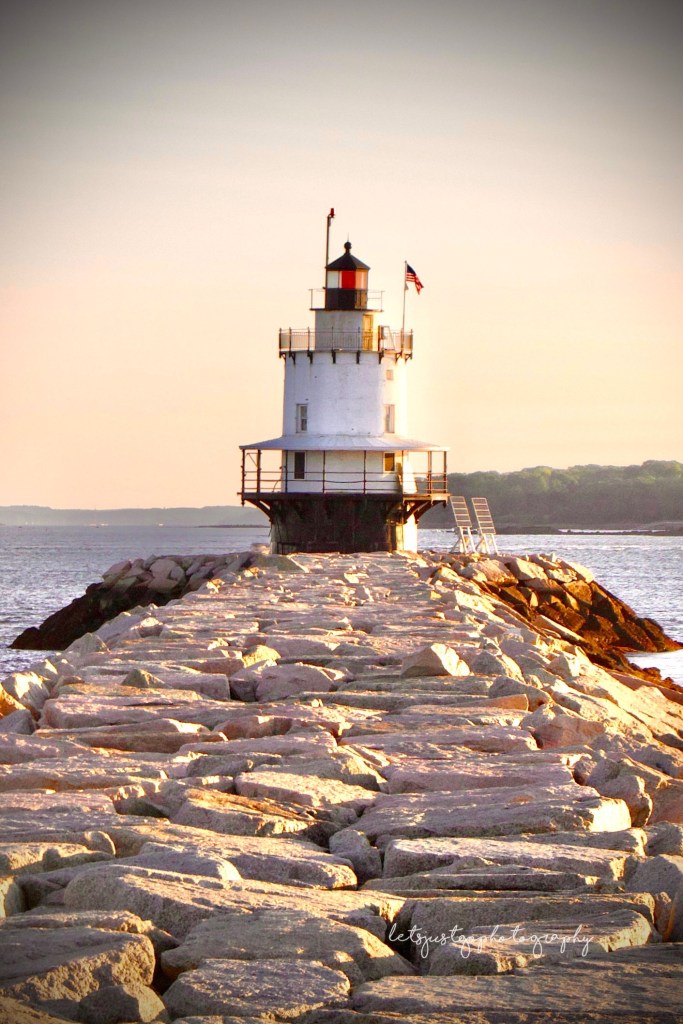
The Spring Point Ledge Light was constructed by the government in 1897 to warn mariners of a dangerous underwater ledge that extends from the shoreline at Fort Preble in South Portland. Constructed of cast iron and brick, the spark-plug shaped white lighthouse it capped with a black lantern and was outfitted with a fifth order Fresnel Lens, first lit on 1897. In 1934, an underwater electric cable electrified the light and in 1960, the lighthouse was automated and it’s Fresnel Lens was removed. The range of the light is 12 nautical miles with it signal flashing white for six seconds with two red sectors.
In an effort to connect the lighthouse to the mainland and to address damage by ice, the Corps of Engineers constructed a 900-foot, 50,000 ton granite breakwater on top of the Spring Pointe Ledge and in 1999, the light was opened to the public for the first time.
Spring Pointe Ledge Light was added to the National Register of Historic Places in 1988.
What to know before you visit:
Parking is free but limited.
Visitors can walk on the breakwater but the stones have gaps and caution should be taken.
Leashed pets are welcomed.
No specialty parking appeared to be designated.
Bug Light and Spring Point Ledge Light are very close together and are easy to see together. Both are not far from Portland Head Light.
Tips for taking your own Maine Lighthouse tour
Be mindful of the weather. We visited Marshall Point Light and Nubble Lighthouse twice, both due to the weather. Fog can roll in quickly or a cloudy, rainy day can affect visibility (the photos below show our experience with weather). Bring along a jacket. Maine’s lighthouses are along the water and in open areas so even on a nice day, a strong wind can be blowing and it can be much cooler in these locations, especially on breakwaters.

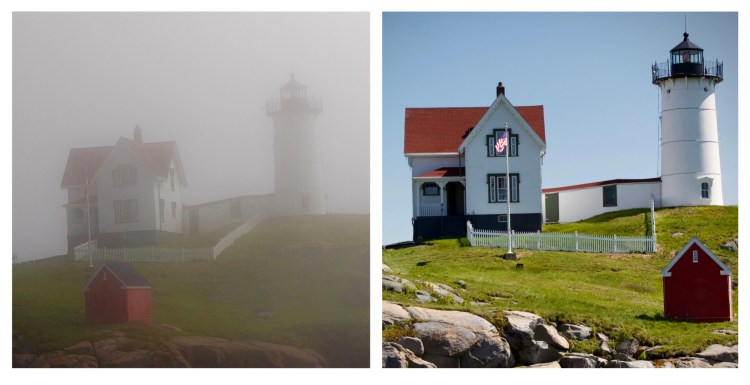
We traveled to Maine at the end of August and the weather was cool in the morning and evening and temperate during the day. We were lucky to have only one rainy day. We also did not plan too far in advance. Our trip was planned within two weeks of our travel with the understanding that many schools were back in session and the height of tourist season was finished for the summer.
We planned our trip to have two central bases. We stayed in Rockland, Maine and visited Marshal Point, Owls Head, and the town of Camden from this base. We then moved to Portland, visiting Pemaquid Point along the way. In Portland, we visited Portland Head Light for the first time in the late afternoon and got up early for a sunrise tour of Portland Head, Bug Light, and Spring Point Ledge Light, seeing three lighthouses before 8am! After our very early tour, we treated ourselves to donuts from The Holy Donut in Portland. Our first visit to Nubble Lighthouse was as we entered Maine on the first day of our trip and after stopping at the Maine Visitor’s Center. Due to the fog we encountered, we drove from Portland for our second visit before heading home.
While these lighthouses were all easily visited, many others are only viewed by boat and tours are available that can take visitors to see lighthouses that are at sea. If this option interests you, be sure to stop by the Maine visitor’s center for more information, look for recommendations through TripAdvisor, or look for sources on line. We will need to try that option for our next visit!
I hope our trip has inspired you to plan your own Maine Lighthouse tour.


Copyright © 2026. Let’s Just Go, All Rights Reserved.

 Let’s Just Go!